
By: Camden Baucke MS LLP
Peace is hard to come by these days.
Not just with wars, struggling economies, and scandals; but with our everyday lives.
You might experience a low-grade anxiety gnawing at you all day, and that anxiety might elevate into panic.
Negativity is a constant drain, but positivity can be as well.
Even if you’re constantly taking on exciting tasks, it comes with an energy cost.
Exhaustion, mental fog, and burnout are the cost of constant panic, worry, and excitement.
It’s like withdrawing from a bank account, but never refilling what you took out – eventually it nears empty.
You must refuel yourself with peacefulness – something desperately needed in today’s world.
While you can’t control the world, you can start to foster peace for yourself.
In this article, I will describe what peacefulness is, barriers to it, and how to overcome them so you can finally rest.
Dimensions of Emotions
To cultivate peacefulness, you need to understand what it is.
Our emotions have two dimensions: (1) Valence & (2) Arousal
Valence is the spectrum between negativity and positivity, with neutral in the middle.
Essentially, positive valence emotions feel pleasurable, negative valence emotions feel stressful.
Arousal is the dimension that lets us know how intensely we feel stress or pleasure.
High arousal emotions cause significant alarm in the body with increased blood pressure, heart rate, and so on.
Low arousal emotions are easier on the body and demand little to no physical response.
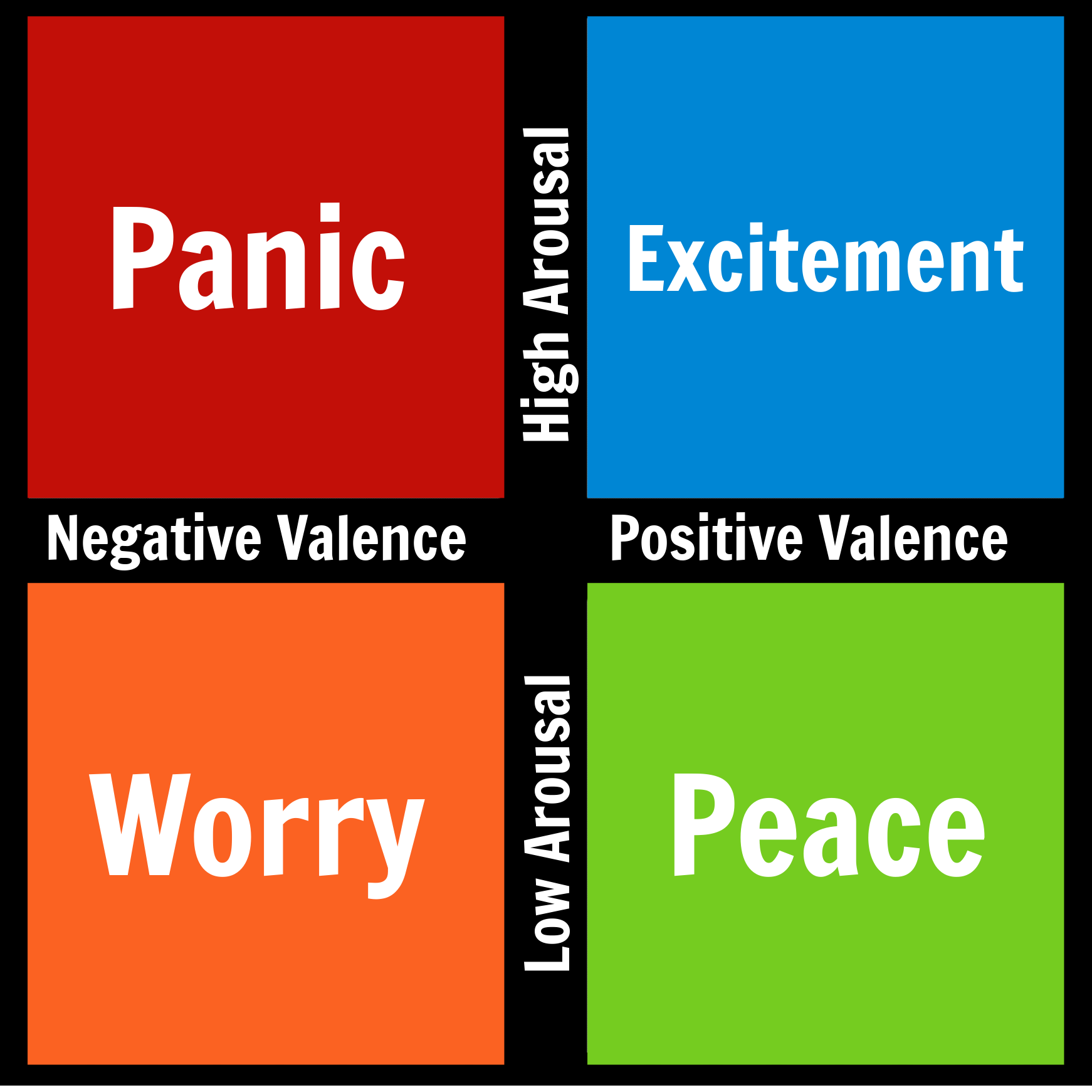
The Four Quadrants of Emotion
Here is a basic description of each quadrant of emotion:
Worry – Low Arousal Negativity
Worry is the subtle anxiety or dread that underlies everyday life.
It’s not a blaring alarm, but it raises the stress of everything you do.
This often feels like hopeless, helplessness, persistent depression, and generalized anxiety.
Panic – High Arousal Negativity
Panic is when the alarms go off in your mind and activates your body’s survival mechanisms.
It’s the feeling of immediate danger, causing your mind to prepare your body by releasing hormones.
Cortisol and adrenaline increase your blood pressure and heart rate, sending blood to your muscles to either fight or run.
It can also overwhelm the body and leave you feeling frozen.
This often feels like heart palpitations, sweating, shallow breathing, and racing thoughts.
Excitement – High Arousal Positivity
Even if you’re taking on an exciting challenge, it’s still a challenge.
Excitement is when the body goes through similar physical preparations as panic, but you’re looking forward to what you’re preparing for.
Roller coasters and job interviews can be exciting – fun, yet draining.
Excitement is tied to hope, so it’s important to be excited for things to come.
Peace – Low Arousal Positivity
If 75% of the quadrants are draining, this is the rejuvenating 25%.
Peace is calmness – where your body is unalarmed and your mind is not focused on what’s coming next.
It is mindful of the moment, unafraid of what dangers might appear.
Peace is restful because there is no demand on your brain or body to be vigilant.
It gives your attention and heart a break.
It’s the stillness in which you notice every detail of life around you – making vibrant and detailed memories you can savor for years to come.
Gatekeeping Ourselves from Rest

For one reason or another, we can keep ourselves from fostering or enjoying peaceful moments.
Here are few examples I commonly hear:
“I Haven’t Earned It Yet”
- What would you have to do to earn rest?
- This is a rule – when and where did you learn it?
- Who told you that you cannot rest until all responsibilities are completed?
- When might this rule not apply?
- Is peace something you earn or do you allow yourself to have it?
“My Intrusive Thoughts are Too Loud”
- These thoughts are usually ignored with distractions – and peace isn’t distracting enough to keep them hidden.
- What are your intrusive thoughts usually about?
- How do they make you feel?
- What kind of decisions would these actions want you to make?
- Would you be willing to seek therapeutic services to address these intrusive thoughts?
- Intrusive thoughts need to be addressed, not just when peace make them more obvious.
“It’s Wasting Time”
- Is your peace of mind so worthless to you that it’s a waste?
- What do you consider to be wasted time and why?
- You can’t sustain long-term efforts without moments of peace, rest, and recovery.
- If peacefulness refuels you, then is it really a waste?
- What if all your efforts depended on how much time you spent resting?
“It Doesn’t Matter”
- What about peacefulness makes it not matter?
- Does everybody’s peace not matter as well as yours?
- If peace promotes your well-being, why doesn’t your well-being matter?
- Peace matters, not just for every individual and their nervous, cardiac, and immune systems, but for the world.
“I Have Too Much Going On”
- Is everything else you have going on more important than peace?
- What are you prioritizing over your well-being?
- If you don’t make time for peaceful moments, it could degrade your health.
- If your health degrades, you might be less capable of fulfilling your responsibilities.
- How can you start helping yourself so you can sustainably help others?
- Peace of mind isn’t handed to you – it’s something you seek for yourself.
“It’s Too Boring”
- If your life has been non stop excitement, panic, or worry, of course peace will feel boring at first.
- Peaceful moments allow you to be more mindful and take in more stimuli.
- After a short amount of time of peaceful rest (and boredom) your brain’s default mode network (DMN) activates leading to greater creativity.
- It’s hard to slow down a busy life, but once you cross the threshold, you can start to savor peace.
- If you only experience distressing emotions, positive or negative, boredom might be exactly what you need.
“It Will Make Me Lazy”
- Peace is an experience; not a personality trait.
- Denying yourself peace is like denying a car its fuel – its self-sabotaging.
- Why are you afraid of “being” lazy?
- When did you learn that normal and necessary peacefulness is lazy, negative, and bad?
- Greater challenges require greater amounts of rest – the opposite of what lazy supposedly is and means.
Signs You Need More Peace in Your Life

Persistent arousal with no peacefulness or rest leads to a plethora of symptoms including:
1 – Sleep Disturbances
- Peacefulness is a crucial aspect of sleep.
- Worry, panic, and excitement can all disrupt the quality and quantity of your sleep.
- Peace fosters comfort, and comfort helps you fall asleep.
- Chronic anxiety can also wake you up in the middle of the night (2:00am-4:00am).
- Fostering low arousal positivity can help you sleep and feel more rested.
2 – Chronic Fatigue
- Excitement and panic immediately exhaust the body, but so does worry over time.
- Peace is the break between stressors – without it, your life is a continuous battle from dusk until dawn.
- If you feel tired for all three meals of the day, you need more peace in your life.
3 – Feeling Empty
- What might be terrifying or exciting at first can drain your enthusiasm or responsiveness over time.
- It’s important to feel excited, but if you’re excited all the time, you never get off the “roller coaster“.
- Roller coasters aren’t meant to be lived on – eventually they stop giving you the feeling you felt in the first place.
- Feeling numb is also a response to be constantly drained by negative emotion.
- Life will give you plenty of highs and lows, but it’s important there’s a peaceful space in the middle.
4 – Irritability
- Exhaustion can easily lead to feeling irritated, even with the slightest frustration.
- You might snap at friends, family, or colleagues due to your constant state of feeling overwhelmed.
- What’s already irritating might become infuriating.
- A nervous system, constantly drained by excitement, worry, or panic, will lead to anger.
- Giving yourself some peace might also create more peaceful relationships.
5 – Apathy
- If you have no bandwidth left, you might just stop caring.
- Empathy and care take energy – if you’re emotionally drained, you might not have any energy to spare.
- You might stop caring about others, what you do, and you might stop caring about yourself.
- Coldness might be a sign you need some peacefulness to warm you up again.
6 – Forgetfulness
- When you run out of physical energy, you usually run out of mental energy as well.
- You might forget where your car keys are, where your phone is, or what day it is.
- You can struggle to recall memories, names, or places because you’re overwhelmed.
- Peacefulness means easing the demand on your brain – giving it a chance to recover.
7 – Distraction
- Because it’s harder to pay attention when you’re tired, your mind might slip into seeking distractions.
- You might doom scroll on social media, binge-watch a television show, or drink alcohol.
- If you have negative thoughts, in addition to feeling tired, you might seek to drown it out with distraction.
- Don’t mistake distraction for peace – distraction is avoidant, but peace pursues the value of the moment.
8 – Isolation
- Due to fatigue, you might prohibit any more stimuli from entering your life in the form of relationships and hobbies.
- If you don’t have enough energy to manage your interactions with people, you might lean into loneliness to find relief.
- If you are too drained to take on an effortful activity, you might deny yourself the chance to pick up a hobby.
- If you simply don’t find peace important, you may sacrifice the activities and people that make life feel more peaceful.
6 Ways to Invite Peace Into Your Life

Here are just a few tips for fostering peace in your life to find a better balance:
1 – Self Permission
You’re the only person who knows if you need peace.
You also have the power to foster peace on a daily basis.
Give yourself permission – if you’re an adult, you don’t need to wait on anybody – you also don’t need to follow anyone else’s rules so they can give you permission to rest.
Give yourself permission, and don’t you dare ask for forgiveness for something that is not wrong – it is necessary.
2 – Make a Peaceful Atmosphere
You can make life more peaceful wherever you want to feel it.
If you want to make home more peaceful, invest in it – limit distractions and create more cozy spaces.
If your office needs to be more peaceful, make changes to your physical space to give more of a sense of ease.
If you can shape your environment with the intention of fostering peacefulness, chances are that it will reciprocate in kind.
3 – Take Down Barriers to Peace
Don’t ignore what stands between you and feeling peaceful – address it head on.
Is it intrusive thoughts? Go to therapy.
Is it pressure from your family? Set boundaries.
Is it an overbearing boss? Find a different job.
Knock down barriers to peace – then you can access it without jumping through any hoops.
4 – Start Slow & Let Peacefulness Grow
A life of peacefulness doesn’t happen all at once – it is an incremental process, starting with just a few efforts.
Find at least 2 ways in which you can foster peacefulness – one daily and one every week.
This lets you test out the waters of peacefulness – to grow more accustomed to it and its benefits.
5 – Find Purpose in Peace
Peace might be the absence of arousal, but it isn’t devoid of meaning.
Why are you choosing to be peaceful at a specific moment in a specific way?
Having an answer to this question provides a mantra – a grounding statement to base your actions on.
You could recite all the health benefits I’ve given you thus far, but that isn’t personal enough to be effective.
Why are YOU making the CHOICE to foster peace in THIS WAY?
6 – Make Time for Peace
Peaceful moments don’t have to be subtle breaks between frantic activities.
You can make peaceful moments – you can put them in your schedule and invest in them with your time and resources.
Even if you don’t have another second to spare in your day, you can transform a situation from intense to peaceful.
If you’re driving home from work, savor the journey.
If you’re taking care of the kids, take a moment to cherish their existence.
Peace isn’t a commodity – it is a necessity we can foster for ourselves.
Final Thoughts

Peace is important – it helps us navigate the other 75% of emotions that life brings.
So don’t put it on the backburner anymore – don’t let peace be the last 20 minutes of your day.
Put peace in your schedule and inject into situations that desperately need it.
Lay down, read a book, look at the clouds, listen to the breeze, enjoy the sunset, and feel every breath.
In a world that discourages rest and incentivizes the other 75% of exhausting emotions, permit yourself to seek peaceful feelings.




 Reflections
Leave a comment