
By: Camden Baucke, MS, LLP
Conflict isn’t fun — but it’s not inherently bad.
In fact, you might fear conflict, opting to be a chameleon who can fit in everywhere and disturb no one.
However, avoiding conflict is not nice, healthy, or helpful — it’s simply an attempt to preserve your emotional safety.
You might type and retype the same text for twenty minutes, apologize when you’re the one who’s hurt, constantly downplay your pain with a plethora of “I’m fine’s“, and avoid problems until your resentment or rage bursts at the seams.
You might also rationalize this fear as something normal like being “shy” or something seemingly positive such as being “agreeable” or having “bigger fish to fry“.
Unfortunately, there’s almost no bigger fish to fry than conflict avoidance.
Conflict is necessary and healthy for work, personal relationships, and everyday interactions.
Without it, you are one tool short of a full belt you need to navigate the complexities of relationships.
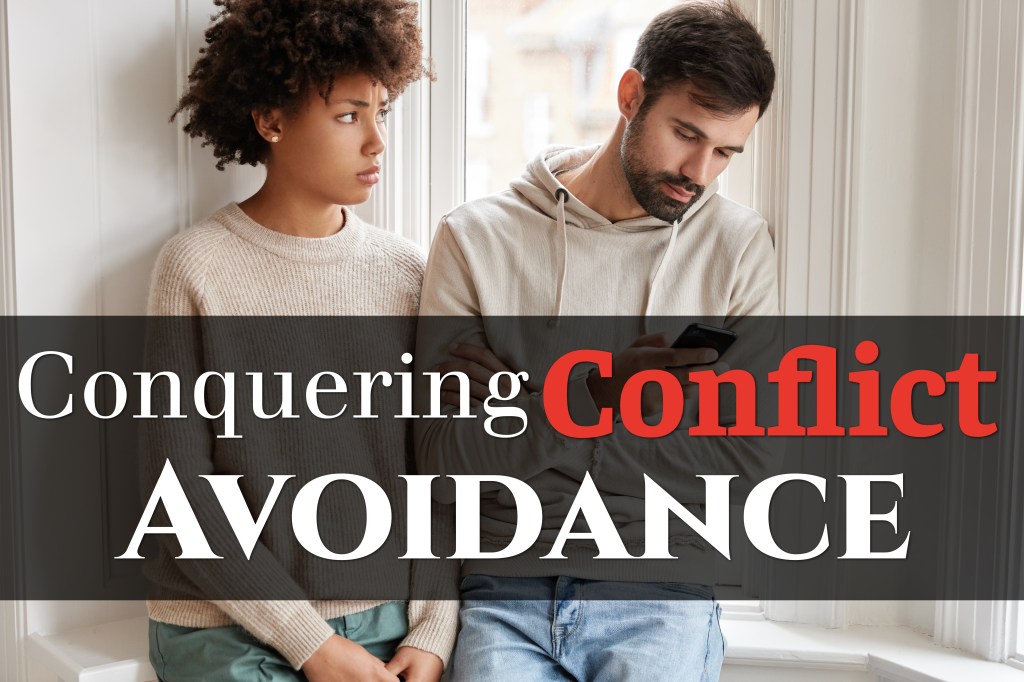
In this article, I will describe what conflict avoidance is, why you may fear conflict, and how to start having healthy conflict.
What is Conflict Avoidance?
Conflict avoidance is not a personality trait — it is a behavioral tendency to minimize, suppress, escape, or prevent any form of conflict because it feels emotionally threatening.
Let’s break down the three forms of conflict avoidance:
1 – Preventing Conflict
- Becoming a people-pleaser — constantly ready to agree no matter how much you truly don’t.
- Suppressing your preferences — never expressing what you want or even what you need.
- Keeping the peace — ignoring negativity and true transgressions just to ensure you don’t fight back.
- Excessively apologizing — using your manners as a tool to placate others and prevent conflict.
2 – Escaping Conflict
- Abandoning conversations — creating physical distance to literally escape a conflict.
- Ghosting conversations — emotionally, mentally, and verbally withdrawing from a conflict.
- Shutting down — presenting an affectless face and mentally dissociating.
- Changing the Subject — shifting the attention to something less threatening to you.
3 – Pretending Conflict Doesn’t Exist
- Ignoring Hurt Feelings — Trying to move on with your day, but your negative emotions fester within.
- Refusing to Discuss Problems — Reacting harshly or avoidantly when asked to speak about conflict.
- Hoping Issues Disappear — Ignoring any conflict, possibly shutting down anyone’s attempts to have it.
- Compensating Afterwards — Feeling the need to distance yourself or placate the other person to regain their favor or your personal safety.
Why Avoid Conflict at All?
Conflict avoidance is a learned behavior — It’s more of a response than anything, but not to the conflict you’re currently experiencing.
It’s a learned association from the past, which informed your perspective of conflict.
Conflict might be associated with several of the following:
- Rejection
- Humiliation
- Punishment
- Unpredictability
- Shame
- Abandonment
While these seem like inherent traits of conflict, they’re not — that’s a cognitive association.
That just means you had an experience that paired a stimulus (conflict) with a meaning (dangerous).
Current conflict might seem identical to the previous stimulus you experienced, causing you to expect more of the same result.
This is not an inherent flaw – it’s the same process as learning just about everything.
Except this lesson often originates in a vulnerable time in your life.
Childhood Sources of Conflict Avoidance
After decades of research, there are several contexts in childhood that are linked to conflict avoidance later in life.
Emotionally Volatile Caregivers
Your childhood home is your first chance to pair the stimulus of conflict with a meaning.
For children with emotionally volatile caregivers, the meaning of conflict likely became as volatile as the parents who modeled conflict — between caregivers and with the family as a whole.
Caregivers who fight with yelling, name-calling, shaming, threats, and/or physical aggression are emotionally volatile — teaching their children that conflict is the same as violence.
Hypercritical Parents
Critical parenting transforms mistakes into shame — turning small and natural events into large ones with catastrophic meaning about you and your personality.
Their “constructive criticism” or “brutal honesty” were rationalized methods to let loose their own emotional turmoil onto you — picking apart your personality with minor, insignificant, and natural outcomes they labeled as punishable “failures“.
Emotionally Unpredictable Homes
For children, structure and predictability create safety — but emotionally unpredictable homes pose an incredible risk.
Conflict, with serious consequences, could occur at any time, leaving you unable to readily protect yourself.
If one parent has a bad day to no one’s knowledge, and comes home to take it out on the family, a child learns that conflict is unpredictable, because a parent’s emotional control is not predictable either.
If you’re constantly waiting for the next shoe to drop in the place you call home, then you’re hypervigilant in the one place in the world where you’re supposed to feel safe.
Parental Stonewalling
The silent treatment is a form of emotional abandonment.
It associates conflict with losing the people you need most — such as your parents when you’re a vulnerable and developing child.
It also forces the child to be the healer — to end the conflict no matter what because they need their parents back.
It’s a parent taking advantage of their child’s life-or-death need for their physical and emotional presence.
Threatened Assimilation
Disagreement means difference, and difference might not be tolerated at home.
Parents might force you to assimilate, to agree with them even on the smallest matter.
They may threaten you with conflict if you don’t dress like them, talk like them, think like them, and so on.
Even different wants or needs might threaten the assimilation your parents demand — creating an association between difference and danger.
Parentification
Every child needs a home free of unhealthy conflict — if the adults aren’t stepping up to the challenge, a child will.
A child might minimize or mediate conflict in the home, acting as a small therapist or negotiator.
Unfortunately, this means that a child is no longer a child — their assumption of an adult responsibility, for their own safety, decimates the wonder of childhood.
Even worse, it makes the absence of all conflict seem like the wisest and most mature choice.
A Home Made of Eggshells
Walking on eggshells is just another way to describe hypervigilance — a constant and distressing state of alert.
If people at home are constantly able to make you rue your day for a myriad of reasons that are not your fault, then of course you will tread lightly.
It would make sense you would avoid conflict entirely — because all you’ve known conflict to be is emotional volatility, consequent pain, and having to take responsibility for what isn’t your responsibility or make humiliating amends for what wasn’t your fault.
Common Signs of Conflict Avoidance
1 – Emotional
- Anxiety before or during difficult conversations — even if it is purely about differences.
- Guilt for expressing your wants or needs.
- Fear of disappointing, hurting, or inconveniencing others.
- Taking emotional responsibility — even if it’s not yours to take.
2 – Behavioral
- Saying “yes” when you only want to say “no“.
- Avoiding feedback of any kind — even if you have to shut down the person providing it.
- Dodging emotional scenarios.
- Appeasing others and always trying to stay on their “good side“.
3 – Relationship Patterns
- Resentment toward yourself and others — the emotions underlying your conflict accumulate with nowhere to go.
- Emotional distance, staying as superficial as possible in the deepest of conversations.
- Burnout — fending off conflict often comes at a degrading cost.
- One sided-relationships — constantly being the “kind” person, while others decide to be aggressive.
- Passive-aggression — The brain’s way of trying to engage in conflict without being held responsible for it.
- Explosive outbursts after long periods of silence — when your bottled emotions burst forth from their captivity.
Grace for the Conflict Avoider
Conflict avoidance is a haunting echo of the past that can invade every new and wonderful relationship you make.
If you never explore this adaptation, its misery may continue under the guise of normalcy.
As a strategy, conflict avoidance once made sense — it was an effective adaptation for the time.
Your nervous system wasn’t irrational and your brain wasn’t broken — it was trying to protect you.
But just because something is adaptive and previously effective doesn’t mean it is anymore.
If you avoid conflict, give yourself some compassion — those who come to believe all conflict is threatening have been all too threatened by previous conflict.
However, if you’re an adult, conflict is now your responsibility and you can’t afford to keep avoiding it.
Because there’s such a thing as healthy conflict, you don’t need to.
Redefining Conflict
Conflict is not inherently bad or dangerous — it’s not even inherently a fight.
Conflict simply means that two or more things don’t match — they’re simply different.
It’s a mismatch of:
- Preferences
- Expectations
- Needs
- Boundaries
- Values
- Behaviors
To conquer conflict avoidance, you must start with a cognitive shift — the entire premise of conflict must change.
- The conflict of the present is not the same as the conflict you adapted to.
- There is a vast difference between healthy and unhealthy conflict.
Healthy Conflict Types
Healthy conflict often arrives in two different ways, the first being:
1 – Plain Difference
You likely differ in a million ways from those you love, including:
- Where you want to eat.
- How you want to parent your children.
- When you want to go on vacation.
- Which chores you want to do.
- Your communication preferences as a whole.
When managing each of these differences, the goal is negotiation.
Nobody has done anything wrong, and you’re not being greedy just by feeling, wanting, or being different.
To navigate difference, all you need is:
- Curiosity
- Compromise
- Flexibility
- Understanding
Avoidance is not the solution to difference — you don’t need to sacrifice 100% of your wants in fear that expressing them will earn retaliation. You can give up 10%, and so can others, so that everyone gets 90% of what they want — you just have to courageously express whatever it is others can sacrifice their 10% for.
2 – Transgression
It is not possible to live without mistakes — it’s inherent in the process of learning and navigating the complexity of relationships.
Conflict often happens with the following transgressions:
- Breaking someone’s trust.
- Lying.
- Insults.
- Violating someone’s boundaries.
- Forgetting commitments.
- Unintentional injuries.
However, the true concept of transgressions probably doesn’t match the version you learned growing up — you were likely taught that any insignificant sign of difference or meaningless mistake was deserving of conflict.
It’s worth clarifying what is a transgression versus what someone interprets as a transgression — you’re not responsible for someone’s interpreted transgressions (that’s often what makes volatile childhood homes so emotionally unpredictable).
When you are responsible for a transgression, you simply:
- Accept the existence of your actions — no more, no less.
- Take accountability and validate the damage you might have done.
- Ask for forgiveness and offer assurance of changing your behavior.
When you hold someone accountable for transgressing against you, you simply:
- Describe the account of the transgressors actions — no more, no less.
- Ask them to take accountability for what they did and how it affected you.
- When ready, forgive the other individual and ask them to change their behavior.
Transgressions are a great opportunity for healthy conflict — all it takes is trust that your current conflict is different from your past conflict.
What Happens After the Conflict is Over?
Conflict can be healthy, but what matters most is how you repair afterwards.
Many people avoid conflict because of what they believe comes after — a situation incapable of being repaired or a demanding responsibility for you to manage.
With healthy conflict, you don’t have either — what matters most is repair.
After Conflict with Strangers
Find respectful closure — you don’t need emotional intimacy, you just need a way to carry on with your day.
After Conflict with Friends
Reconnect — trust only grows when friendships survive conflict.
After Conflict with Romantic Partners
Reclaim closeness — Research consistently shows that healthy conflict increases intimacy, more so than not having any conflict at all.
You can reclaim closeness with:
- Expressing affection.
- Mutually providing reassurance.
- Vulnerably finding emotional connection.
- Developing a shared meaning of the situation.
Conflict isn’t about winning, and it doesn’t truly end until the relationship feels safe again.
With Yourself After Conflict
Ground yourself — don’t fly off into the fantasy of self-criticism, stay in the reality where the healthy conflict was.
You don’t need to ruminate for what you already know and you don’t need to self-punish for what has already been addressed.
If you have additional worries, mind-reading won’t provide you an accurate answer — if you’re worried about your part in a relationship at all, it’s time to have more healthy conflict with the people who can speak truthfully about their perspective.
Final Thoughts
Conflict avoidance is not weakness — it begins as protection, but slowly becomes a barrier to a happy life.
Not all conflict is unhealthy, and that kind of conflict usually lies in your past.
Healthy conflict fosters understanding, not destruction, so actively seeking healthy conflict is not self-destructive.
The goal is not to be argumentative or petty, it’s to allow you to be safe and present when your relationships briefly become uncomfortable.
Your past is not your present, and the people who would love to have healthy conflict with you today are not the people in your past who drove fear into your heart.
Conflict is no longer something to survive — it can now strengthen trust, deepen relationships, and help others understand you as much as you understand them.


 Reflections
Leave a comment