
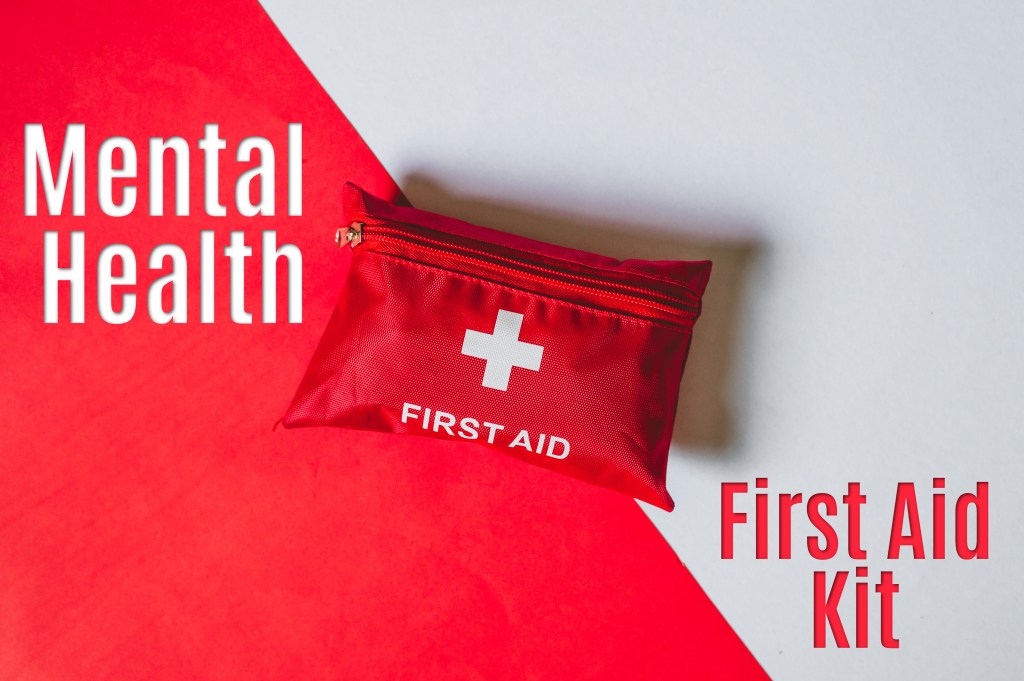
By: Camden Baucke MS LLP
If you cut your knee, you grab a cleaning pad and a Band-Aid from a first aid kit.
If you notice your chest tightening and mind scattering, what do you use for that kind of pain?
As a therapist, I find it very useful to always have a mental health first aid kit on hand.
Unfortunately, there are no widely used mental health first aid kits – which means you have to get creative.
In this article, I’m going to tell you about what a mental health first aid kit is, how to make one, and when to use it.
So the next time you start to panic or spiral in the middle of your average day – you have something on hand to help.
What is a Mental Health First Aid Kit?
A mental health first aid kit is usually a container full of objects for when you’re feeling near a crisis.
It can be any container like a bag, box, or pouch – anything that can store what you need.
The objects inside of a mental health first aid kit should directly address the issues you expect.
This is where you need to both know yourself and be creative.
If you have a pre-existing condition of anxiety, depression, inattention, obsession – then you should account for that.
Your mental health first aid kit shouldn’t address other people and their circumstances – it should specifically address yours.
What’s in Your Mental Health First Aid Kit?
Again, your first aid kit should be tailored to your specific needs, including what you will feel in times of crisis.
These are just a few suggestions and examples:
1. Grounding Objects
To ground yourself and draw attention back to your senses, try including some objects that help do just that:
- Stress ball.
- Play putty.
- Essential oils (peppermint, eucalyptus, lavender).
- Fidget toy.
- Piece of textured fabric.
- Dice.
- Chewing gum.
- Tea-bag.
Between feeling and smelling these items, you can help activate the parasympathetic nervous system (PNS), which can help calm you down.
2. Breathing Instructions
Taking control of your breathing is an important aspect of self-calming – something you can remind yourself with:
- Diaphragmatic breathing instructions on a note card.
- Small pinwheel for exhaling.
If you can have these on hand, you can control your breath and start to reduce your heart rate, muscle tension, and stress.
3. Mental Documentation Tools
It’s best to express and explore some of the emotions fueling the current issue, using things like:
- Small notebook or journal.
- Pencil or pen.
- Sticky notes.
- Small cutout of a feelings wheel.
Sometimes we need to release the stress from our minds and let it out onto paper.
4. Comfort Objects
In moments of crisis, sometimes reminding ourselves of important people or things can bring us back down:
- Photo of a loved one.
- Small sentimental object.
- A letter to yourself.
- Favorite quote(s).
When you feel alarmed, sometimes you just need to find things that comfort you.
5. Thought Challenging Tools
Once you get your thoughts out, maybe you can start to understand them better with:
- notecard prompts about how you’re feeling.
- “What do I think is happening?”
- “What evidence supports or contradicts this thought?”
- “What would I tell a friend in my situation?”
- Affirmation statements.
- notecard reframing prompts.
- “This is [feeling], but [reframing].
- i.e. this is [frustrating], but [it’s a temporary situation].
This doesn’t mean neglecting or invalidating yourself – it means challenging biased or catastrophic thinking.
7. Social Support Resources
When crisis don’t slow down, sometimes you need some social resources to support you.
- List of trusted people to contact.
- Potential therapist contact number.
- Suicide and Crisis hotline (https://988lifeline.org/).
- Small reminder that you don’t “have to do this alone“.
No matter how hard the challenge is, there are people ready and willing to support you.

When to use a Mental Health First Aid
Because you’re the primary receiver of your own internal signals – you need to listen to yourself.
Sure, loved ones or colleagues can notice when your vocal tone or physical demeanor changes – but only you can feel the emotions behind those expressions.
Don’t wait too long to pull your first aid kit out – once you notice it starts, it’s best to manage it before it gets worse.
One thing you could try is ranking your level of distress on a scale.
On a scale of stress from 1 to 10, with 1 being totally relaxed and 10 being totally panicked, what’s your threshold number?
For example, I commonly use a 7 as a threshold number – once your stress goes beyond 7, it’s time to take out the mental health first aid kit.
Honestly ranking how you feel might be tricky, but you only get better with practice.
Example:
Meet Keiron.
Keiron works at a local law firm and he has only started to get busier in the past year.
One day, Keiron feels a sudden twinge in his chest, his thoughts start to spiral, and he notices that he is beginning to experience an anxiety attack or panic attack.
He thinks to himself and ranks his anxiety as an 8 out of 10.
Keiron closes his office door, drops the blinds, and pulls out his mental health first aid kit.
First, he grounds himself by chewing on some gum (taste), rubbing some essential oils on his hands (smell), and squeezes a stress ball (touch).
Next, he pulls out a cutout of a feelings wheel and writes down his emotions and thoughts with a pen on some sticky notes.
After he challenges his catastrophic thoughts with a notecard prompt, he pulls out a photo of his brother.
As a result, Keiron processed his emotions, identified the thoughts causing his distress, challenged those thoughts, and grounded himself in his senses and his love for his brother.
Final Thoughts
Not everyone’s mental health first aid kit will look the same.
I hope yours will be filled with what meets your specific needs.
Life can pull us in several directions and leave our imagination to create terrible looking futures.
Having a mental health first aid kit on hand can pull you back to the basics:
You’re here, you’re loved, and your thoughts aren’t being nice right now – but that doesn’t mean you can’t be nice to yourself.

 Reflections
Leave a comment