
By: Camden Baucke LLP
Conflict often feels bad, but in many cases it is actually a vital aspect of maintaining relationships.
It might not seem that way when you’re in the throws of it, but it’s what allows us to find solutions.
Conflict itself just means “difference” between two things that might be incongruous with each other.
If you want harmonious solutions inside your relationships, you’re probably going to need some conflict.
However, what if one party is willing to have that conflict, and the other is not?
What if you constantly appeal to them to address the issue or open up at all?
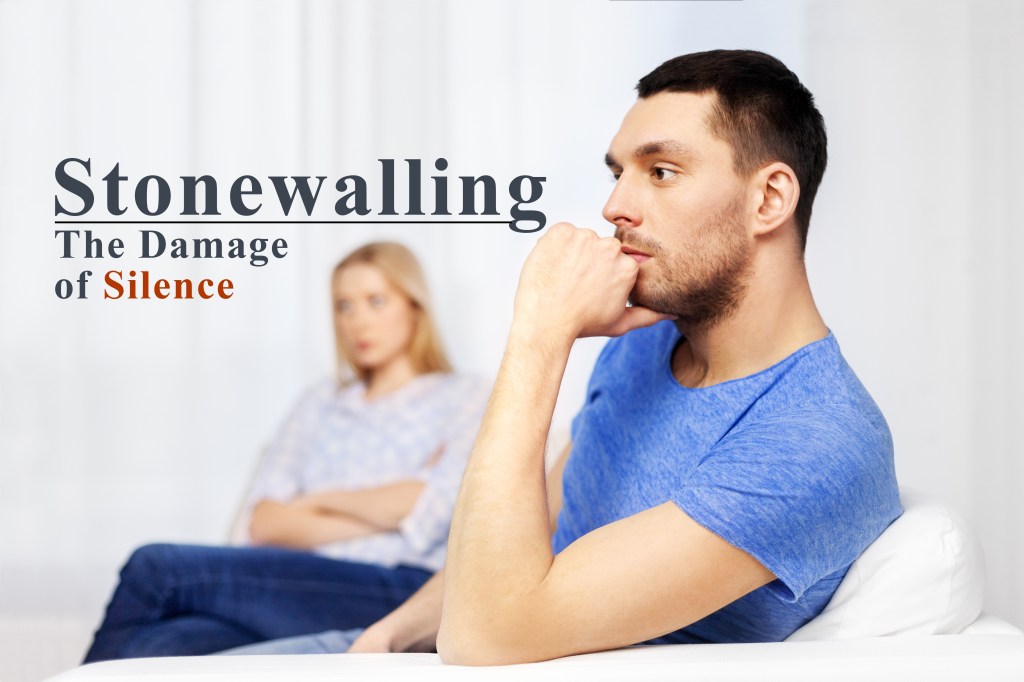
It could mean that someone is stonewalling – which could be damaging the relationship, even with silence.
In this article, we will cover what stonewalling is, how it damages relationships, and what you can do about it.
What is Stonewalling?
Stonewalling is one of four communication styles called the four horsemen of the apocalypse.
The Gottmans, world renowned relationship psychologists, identified these four styles as statistically significant predictors of the end of a relationship.
While the other horsemen like criticism and contempt create noticeable harm – stonewalling is much less obvious because it’s harm via absence .
Stonewalling is a pattern where someone, in a relationship, withdraws or refuses to engage – most often with conflict.
You can (1) avoid engaging in conflict (2) disengage at some point throughout the conversation, or (3) disengage after the argument.
Scenarios for Stonewalling
The Gottmans also provided a grouping of scenarios where stonewalling plays a part in different ways.
- Shutdown mid-argument – partner shuts down, goes silent, avoids eye contact, gives one-word answers.
- Asking about feelings – partner refuses emotional engagement with “I don’t know” and “it’s fine“.
- Being Held Accountable – Instead of responding, the partner might leave the room or scroll on their phone.
- Overwhelming Conflict – partner may become affectless – flat expressionless or have a robotic reaction.
- Chronic Conflict Avoidance – partner avoids important topics like money, intimacy, or future plans.
- Silent Treatment Post-Argument – after an argument, a partner will cut communication to assert control or create emotional distance.

How Stonewalling Hurts
Again, conflict is a vital piece of relationship management.
We’re all just unique people trying to intimately exist with other differently unique people – there will always be differences and conflict.
When one person pulls away, the other is still left there.
When there’s a (1) withdrawer and a (2) pursuer in a relationship, then there’s one person who’s avoiding conflict and the other is likely hurting.
The pursuer probably feels alone – physically, mentally, and emotionally.
When they desire to know their partner’s feelings or ask them to take accountability – their intimate issues feel completely unwanted and unimportant.
Stonewalling hurts because it’s not just avoiding conflict or certain subjects – the result is avoiding your partner and the vulnerability they share.
It also makes the pursuer feel completely out of control – they can’t have major discussions in their own relationship.
A conditionality arises in the relationship – you are wanted by your partner as long as you are nonconflicting with them.
Between feeling unwanted and out of control, a pursuer’s self-esteem can be damaged over time.
Stonewalling doesn’t just degrade the relationship, it can damage the self-image of the person left on the other side of that wall.
Purposes for Stonewalling
Now, while stonewalling paints a mean picture, not all stonewalling is intentional.
While all stonewalling is self-protective, and damaging to the pursuer, someone’s purpose might be different.

Trauma Response
For many individuals who stonewall, this self-protective mechanism might have come out of trauma.
If conflict has ever truly meant danger, then it makes sense you don’t want to engage in conflict at all.
The avoidance almost becomes “phobic“, like how an arachnophobe avoids being “killed” by a spider.
Your nervous system might be specifically aware of conflict, selecting the survival mechanism of “flee“.
Stonewalling can be a learned method of avoiding the type of danger that previous trauma might have posed.
Parental Modeling
Stonewalling, as a communication style, might be learned from parents who exhibited it towards each other.
The only intimate relationship you have with conflict might be the avoidance of conflict itself.
If your parents “never fought” or avoided conflict, then you might have learned it from home.
Safety Through Control
Stonewalling is protective through control – the ability to mitigate danger away by withdrawing.
You can easily keep yourself from the perceived dangers of conflict if you never allow yourself to be in it.
However, because relationships involve more than one person, that’s taking away necessary conflict from your partner.
This can also be an additional part of pre-existing controlling behavior – which represents a whole range of issues on its own.
Manipulation
If you seek to control a situation by controlling another person, then you might be manipulative.
That means you would evade conflict to ensure your partner’s behavior fits what you want it to be.
That you could leave or shutdown mid argument to stop the conversation from going any further.
You can give the silent treatment so your partner may apologize, when you are really at fault.
Stonewalling, for manipulation’s purposes, can often turn the “accuser” into the “nurturer“.
If you can coerce your partner into believing they hurt you when they didn’t.
That you wronged them by bringing up conflict or holding them accountable – guilting you into comforting them and apologizing.
Stonewalling can be an accessory to gaslighting, something truly bound to damage relationships.
What about Personal Boundaries?

In the midst of all this, I don’t want you to mistake having personal boundaries with stonewalling.
If you will have a conversation as long as you are safe, then that’s fine.
I would even encourage you to have boundaries that can shape healthy conflict with your partner(s).
Feel free to set the ground rules – no name-calling, criticism, contempt, raised voices, or physical posturing.
However, there are inherent discomforts that you will need to embrace if you want healthy conflict in your relationship.
How to Break Down Walls
If you want to have healthy conflict, and avoid a horseman of the relationship apocalypse, then you need to accept certain truths.
- If you have trauma leading to stonewalling – go to therapy where you can heal and be heard in a safe place.
- Not all conflict is the same conflict you experienced in your trauma.
- In fact, if your partner desires healthy conflict – they are a different person in a different place and deserve to be communicated with accordingly.
- If your parent’s modeled stonewalling – accept that was a poor example and create new and healthy expectations for conflict.
- Again, your partner is not your parent – you need to treat them according to who they show themselves to be.
- If you are desiring safety through control, it comes at a partner’s expense.
- Control might help you feel safer, but it’s a self-destructive shield against a threat that is probably no longer there.
- An inherent part of relationships is sharing control – a mutual vulnerability to be honored.
- Personal control and safety is not worth manipulating and destroying the self-esteem of the people who choose to trust you.

If you’re at the receiving end of stonewalling, this isn’t your responsibility – it’s your choice to react how you will with this information.
If you’re the maker of walls, the withdrawer, then it’s time to become vulnerable.
Sure, it’s a scary and intimidating thought, but vulnerability is the natural cost of relationships- meanwhile the reward could be a healthy and loving connection.
Vulnerability, in conflict, is going to be your biggest challenge – but it’s one worth trying.
You might be wrong in many cases, but your interpretation of that wrong can determine everything.
You’re not a wrong person, wrong personality, or worthless at all – maybe wrong is just a thing like anything else.
Maybe you have to trust that, like conflict as a whole, wrong doesn’t mean danger anymore.
If you avoid conflict, to be safe or constantly in the right, then it’s time to learn how to be wrong.
Only when you expose yourself to the previous threat of vulnerability can you acclimate to the demands of your relationship – to have both conflict and love.
Final Thoughts
Stonewalling is a hard topic, because it’s often understandable but yet so very damaging.
This is where I use my rule:
“you’re not responsible for what happens to you, but you are responsible for what happens through you“.
Our loving partners shouldn’t be punished for the fears that others created.
A pursuer’s willingness to have respectful conflict is an open hand – one you might need to learn how to grasp.



 Reflections
Leave a comment